

Search our site…
Volunteers & Professionals
All safeguarding referrals/requests for support for children and adults in Suffolk now occur via the Integrated Front Door.
It is important that professionals speak with the adult/parent/carers or child, when appropriate, about their concerns and discuss if they are planning to make a referral about their concerns or request additional support. Unless directly sharing the concerns/referral would place a someone at additional risk of harm, it is an expectation of all professionals that these discussions have occurred before any referral is submitted to the Integrated Front Door.
Preparing to make a safeguarding referral/Request for Support
Before making a referral, have you consulted the Safeguarding Adult Framework or Children’s Continuum of Need? These documents provide indicators on the types of abuse which will make completing your referral/request for support easier.
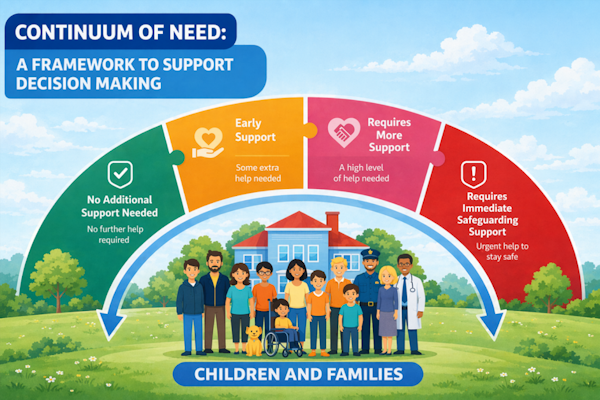
The Suffolk Continuum of Need supports practitioners to understand the needs of children, young people and their families and to identify the most appropriate response. It provides a shared multi-agency framework for considering the child’s lived experience, the family’s strengths, the presence of harm or risk, and the support needed to improve outcomes.
Children and families’ circumstances are individual and can change over time. The levels within the Continuum of Need should therefore not be treated as rigid thresholds or as a linear pathway that families must move through before receiving support. Children may move between levels of need, and some will require an immediate response at a higher level.
Practitioners should use professional judgement, informed by:
· the child or young person’s lived experience and wishes;
· the views and experiences of parents, carers and the wider family network;
· the impact of needs, harm or risk on the child;
· family strengths, safety and protective factors;
· the pattern, duration and cumulative impact of concerns;
· previous support and whether it has led to sustained change;
· relevant statutory duties and guidance; and
· information shared by partner agencies.
The Continuum of Need should support professional analysis rather than replace it. Decisions should be made collaboratively with children and families wherever possible, using the Suffolk Signs of Safety and Wellbeing approach (SOS+) to explore what is working well, what we are worried about, existing safety, and what needs to happen next. Practitioners should also apply a Think Family approach and use the Assessment Triangle to understand the child's lived experience within the context of their developmental needs, parenting experiences, family relationships and wider environment. Together, these approaches support a holistic understanding of the child and help inform proportionate, child-centred decision-making.
Levels of Need
There are Four Levels of Need as agreed by partners of the Suffolk Safeguarding Partnership.
Level 1: No Additional Support Needed
Children and families whose needs are being met through family and community networks and universal services, such as health, education and community provision.
Level 2: Early Support
Some children and families benefit from additional help when needs first emerge. Early Support is a coordinated response involving services that already know the child and family.
Examples include support from:
Schools and early years settings
Family and Youth Hubs
Health professionals
Community and voluntary organisations
Community Connectors
Level 3: Requires More Support
Children with more complex or escalating needs may require support through Family Help. A Family Help Practitioner works alongside the family and wider network to coordinate support and develop a Family and Friends-led plan. This may include statutory assessment and support under section 17 of the Children Act 1989 where the child is assessed as being in need.
Level 4: Requires Immediately Safeguarding Support
Children who may be at risk of, or experiencing, significant harm and require an immediate, coordinated safeguarding response. This may include child protection enquiries and other specialist statutory intervention.
Right Help at The Right Time
Children and young people should receive the right help at the right time, without unnecessary delays or being passed between services. When a child or family needs support, practitioners should work together to understand the child’s lived experience, respond to their immediate needs, and ensure any transition to another service is planned, coordinated and centred on what is best for the child.
Support for professionals to make a safeguarding referral/Request for Support
When unsure whether a referral/request for support is required, you also have the option of to call the Professional Consultation line on 0345 6061499 to speak with a Social Worker - or use the new WebChat facility available at the bottom of this page.
WebChat enables you to seek professional advice from the Integrated Front Door, using your PC/laptop/smartphone. WebChat provides a faster response and is a simpler way of gaining support and advice. WebChat is helpful for professionals who are unable to make a phone call and the ‘conversation’ can be printed. This would be the recommended way to contact the Professional Consultation Line. Referrals cannot be made on this number and members of the public are unable to use this service.
When you are ready to raise a concern, please click on the appropriate below:
Request support or Report a concern for a child
The first time you complete a form you will be asked to create a new portal account. It’s quick and easy to register for an account, and it means the information you send to us is secure.
User guides are available through the 'Report a Concern’ links above.
Urgent?
If the matter is urgent because a child or vulnerable adult is in immediate danger:
Members of the Public
If you are concerned about a child or an adult and unable to use the Portal below, you can call Customer Experience (previously known as Customer First) on 0808 800 4005 (this is a freephone number).
The first time you complete a form you will be asked to create a new portal account. It’s quick and easy to register for an account, and it means the information you send to us is secure.
User guides and video guidance are available below if you need help using the portals.
* All anonymous referrals should now be made through the reporting portal above. If you are a member of the public and need to raise a concern anonymously about an adult or a child, you can also call Customer Experience (previously known as Customer First) on 0808 800 4005.
Confidentiality, Sensitivity and Inclusion
All information is treated with the utmost confidentiality and sensitivity. Both the referrer and the person who is being abused will be included in the decision-making process as much as possible.
Other Referral Options
Local Authority Designated Officer (LADO) Referrals
If you have concerns about an adult working with a child under the age of 18 that you would like to report, please access the LADO page for more information
Help at Home Needed
If you or someone you know needs help at home, or a family carer needs extra support
Self-Neglect and Hoarding
If you are concerned an adult is at significant risk of harm due to self-neglect or hoarding you can make a referral using the forms on our Self-Neglect and Hoarding page.
Safeguarding outside the Home
If you are out and about and feeling vulnerable there are various ways you can access help discreetly:
Ask for Angela
Ask for Angela is the national scheme that helps anyone who is feeling vulnerable on a night out to get the support they need.
Ask for Ani
Ask for ANI codeword scheme
Ask for ANI (Action Needed Immediately) is a codeword scheme that enables victims of domestic abuse to discreetly ask for immediate help in participating pharmacies and Jobcentres (Jobs and Benefits Offices in Northern Ireland).
The scheme was developed by the Home Office with the help of partners including the domestic abuse sector, pharmacy associations and the police. It was launched across the UK on 14 January 2021. The scheme is now managed by Hestia’s UK Says No More campaign.
Over 5,000 pharmacies, including Boots, Lloyds and community pharmacies, are now enrolled in the scheme. People from across the UK have been supported by pharmacists to access support from the police or domestic abuse services.
The scheme is also currently being piloted in 18 Jobcentres and Jobs and Benefits Offices across the UK.
How to make a silent 999 call
If you're in danger, call 999 and try to speak to the operator if you can, even by whispering. You may also be asked to cough or tap the keys on your phone to answer questions.
Call 999 from a mobile
If you don't speak or answer questions, press 55 or tap when prompted and your call will be transferred to the police.
The police will usually be able to find your location.
If you don't press 55 or respond, your call could be ended.
Call 999 from a landline
If you don't speak or answer questions and the operator can only hear background noise, they'll transfer your call to the police.
If you replace the handset, the landline may remain connected for 45 seconds in case you pick it up again.
Calling 999 from a landline automatically gives the police information about your location.